



Lyophilization, or freeze drying, has long been the method of choice for laboratory sample drying. It achieves a high level of dryness with low residual solvent, and its light, powdery “fluffy” finish makes samples easy to remove, weigh, and redissolve. Yet conventional freeze dryers are slow and largely limited to water. Volatile organic solvents and mixtures, such as the water, acetonitrile, and TFA fractions produced by preparative reverse-phase HPLC, cannot be handled effectively.
Centrifugal evaporators have become the go-to alternative for purification laboratories processing many samples in parallel. Even so, stubborn samples can retain TFA or residual solvent, or dry to gums and oils that are difficult to weigh and prone to degradation. As a result, modern purification workflows are increasingly focused on several interconnected challenges:
- Drying water and acetonitrile mixtures without bumping or cross contamination
- Combining fast evaporation with lyophilization in a single run
- Producing weighable, fully dried samples from difficult HPLC fractions
- Reducing process times for high-throughput laboratories
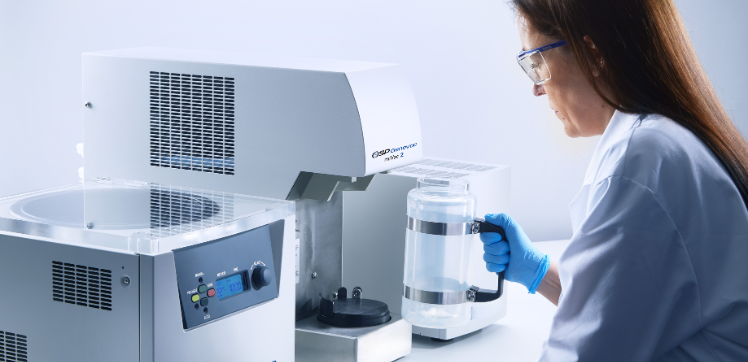
This white paper describes how lyophilization can be carried out directly in Genevac HT-Series centrifugal evaporators. The approach uses rapid evaporation to concentrate samples, then switches to a lyophilization mode for the final few millilitres. Processing time for 96 × 30 ml fractions fell from 48 hours in a freeze dryer to 16 hours overnight. Customer case studies from KuDOS Pharmaceuticals/AstraZeneca, the Novartis Institute for BioMedical Research, and a UK agrochemicals research centre show “fluffy,” solvent-free results from previously intractable samples.