







Freeze-Drying Basics (Part Two): The Freeze Dryer & Its Core Components


The principles of sublimation and low temperature drying described in the previous article can only be applied when a carefully controlled physical environment is created. That environment is provided by the freeze-dryer itself, a system designed to regulate temperature, pressure, and vapor flow so that frozen water can be removed without passing through the liquid phase.
The main components of freeze-drying equipment are:
- Refrigeration system
- Vacuum system
- Control system
- Product chamber/shelves or manifold
- Ice condenser
Refrigeration Systems: How Freeze Dryers Create & Control Cold
The refrigeration system cools the (ice) condenser located inside the freeze dryer, with refrigerant routed through a coil in the condenser. This is known as “direct expansion” (DX) refrigerant cooling. DX refrigeration is uncontrolled by design, and when running continuously, the system will eventually reach its coldest “bottom out” temperature in the condenser.
The refrigeration system is also employed to cool the shelves in the product chamber for both freezing of the product and for maintaining temperature during drying. For tighter control of shelf surface uniformity, an indirect method of cooling is used. The refrigerant is sent to a heat exchanger where it cools silicone heat transfer fluid. This fluid is continuously circulated through the inside of the shelves. A resistive electric heater is added to the heat transfer fluid loop to provide shelf heating. The heater and refrigeration system work together to maintain precise shelf temperature control.
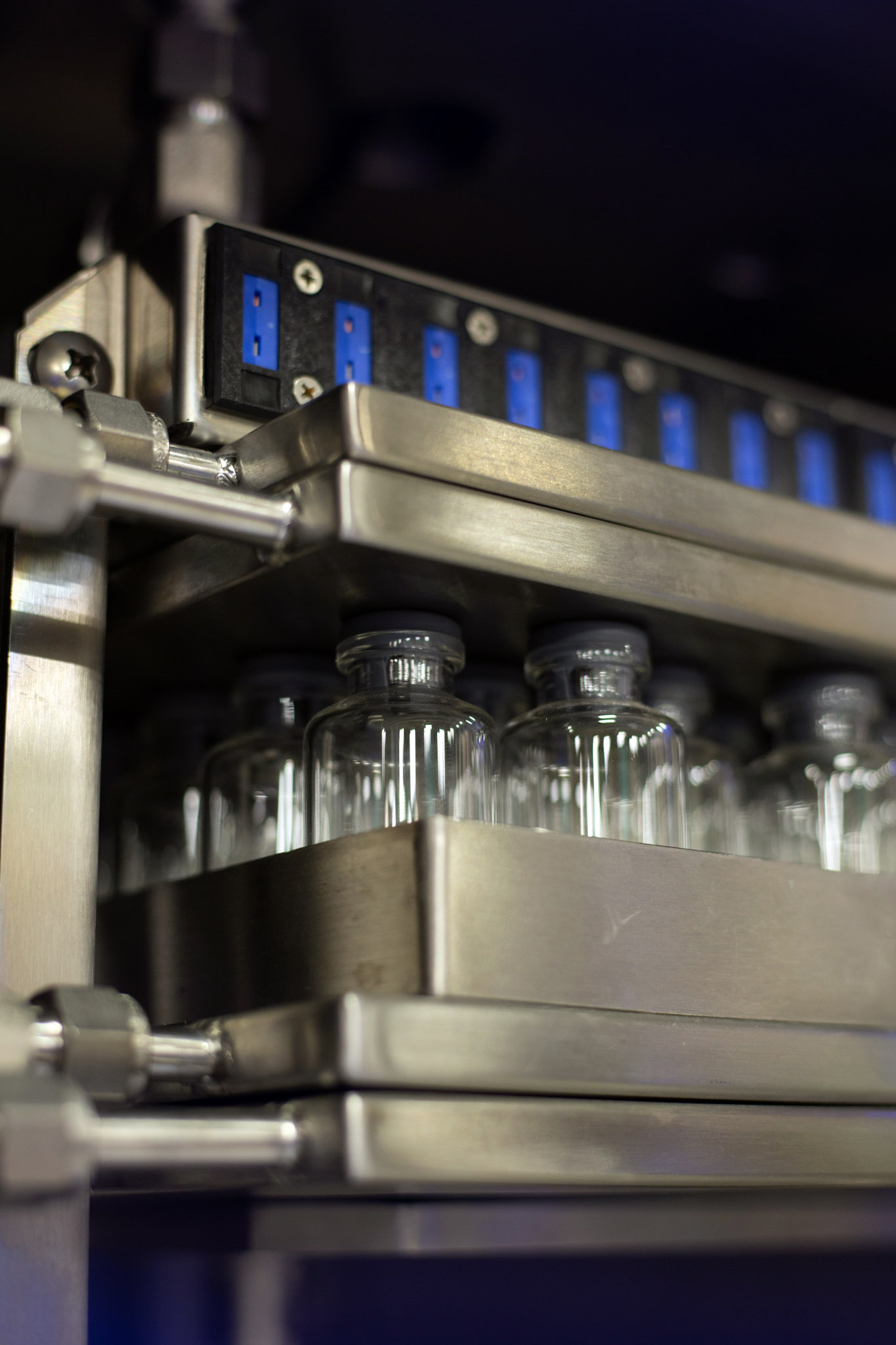
On advanced freeze dryers, a shared refrigeration system is used to cool both the shelves and the condenser. All of the cooling load is at the shelf stack during freezing. Then, during drying, most of the cooling load is at the condenser. Shared refrigeration systems have less components and are more reliable, they are more energy efficient and generate less waste heat. Older freeze dryer designs may have two separate refrigeration systems, one for the shelf and on for the condenser, with each system having its own compressors.
Refrigeration systems on laboratory and pilot freeze dryers are typically cascade in design, where there are two refrigerant circuits working in series. The cold side of the warmer “highstage” intersects with the warm side of the colder “low-stage”. This provides for system temperatures colder than -80 °C. On production freeze dryers, the larger compressors are compound/multi-stage in design, and they can reach -75 °C with a single refrigeration loop.
Vacuum Systems: How Low Pressure is Created & Controlled
The vacuum system consists of a separate vacuum pump connected to an airtight condenser and attached product chamber. Vacuum pumps can be oil-lubricated (rotary-vane) style, or they can be “dry” scroll in design. Rotary-vane vacuum pumps require the use of an oil mist eliminator (OME) to capture oil particles in the exhaust stream, or the exhaust can be vented to outside. They require frequent oil changes based on usage conditions.
Dry scroll vacuum pump designs have become more robust and are now frequently used in freeze-drying equipment. They can reach the low vacuum levels needed for freeze-drying, even with their gas ballast set to open, which makes them ideal for processing products with solvents/acids. Although they provide the benefit of not needing oil changes, the tip seals on dry scroll pumps do require periodic replacement to enable reaching lower vacuums.
For the best control of vacuum to the desired set point, the vacuum pump will run continuously and then a small gas bleed valve will be used to intermittently allow a small amount of gas/air into the system to balance out the vacuum level.
Control Systems: How Freeze-Drying is Monitored & Programmed
Control systems vary in complexity and will usually include several features such as:
- Temperature (shelf, condenser & product probes) and pressure sensing
- Control of system vacuum and shelf (fluid) temperature
- Ability to program a complete “recipe” for freeze-drying
- A recipe manager to save multiple recipes for future use
- Process alarms
- HMI (Human-Machine Interface)
- Data trending and data export
- Manual mode operation
- Synoptic screen showing which systems are active
Advanced control systems can also include the following additional options:
- SCADA (Supervisory Control And Data Acquisition) system to record data
- Data historian with secure encryption
- Secure user ID/Login & Password
- Multiple user groups with different permission levels
- Audit trail for change control of who made what recipe change, when & why (FDA 21 CFR Part 11 requirement).
- PAT (Process Analytical Technology) tools to monitor how the freeze-drying process is progressing
- Automatic system performance tests
Product Chamber: Where the Product is Held During Drying
Product chambers are typically a large chamber with a system of shelves on which to place the product. The standard material of construction is 316L Stainless Steel for both the chamber and the shelves. In simpler form, a manifold with attached flasks functions as the product chamber.
Product chambers are designed to withstand pressure differentials for full vacuum conditions. They can be either square/rectangular or round/cylindrical in design.
Product shelves can be either fixed in place or moveable. Moveable shelves can have a hydraulic or pneumatic ram added for the ability to stoppering vials at the end of the process.
Ice Condenser: Where Ice Vapor is Captured
The purpose of the condenser is to attract the vapors being sublimed off of the product and protect the vacuum pump. Because the condenser is maintained at a lower energy level relative to the product ice, the vapors condense and turn back into solid form (ice) in the condenser. The sublimated ice accumulates in the condenser and is subsequently removed at the end of the freeze-drying cycle, after the product has been unloaded. This defrost step is facilitated by the refrigeration system on laboratory/pilot units (known as “hot-gas defrost”). On larger production units, hot water or steam can be used to speed up the defrost process, together with an automatic drain valve.
The condenser temperature required for a specific product is dictated by the freezing point and collapse temperature of that product. The refrigeration system must be able to maintain the temperature of the condenser substantially below the temperature of the product while it is being freeze-dried.
In shelf freeze dryers, the condenser can be located inside the product chamber (internal condenser) or in a separate chamber (external condenser) connected to the product chamber by a vapor port. This vapor port can have a normally open isolation valve, which can be closed when desired for product unloading, defrost, or for process control end-of-drying measurements know as a pressure-rise test.
The refrigerant coil can be wrapped around the outside of the condenser chamber, providing a “smooth wall” design for the ice to collect on. Alternately, the coil can be placed internally. There are different advantages to both designs. Smooth-wall designs are easier to clean manually and will melt/defrost large ice loads much more quickly if hot-gas defrost is used. Internal coils on pilot units better approximate most production freeze dryer designs and may provide better process scale up data.
Freeze dryers can be informally classified by the type of product chamber:
- Manifold dryers where the product is typically pre-frozen & in flasks
- Shelf dryers where the product is placed in a tray or directly on a shelf
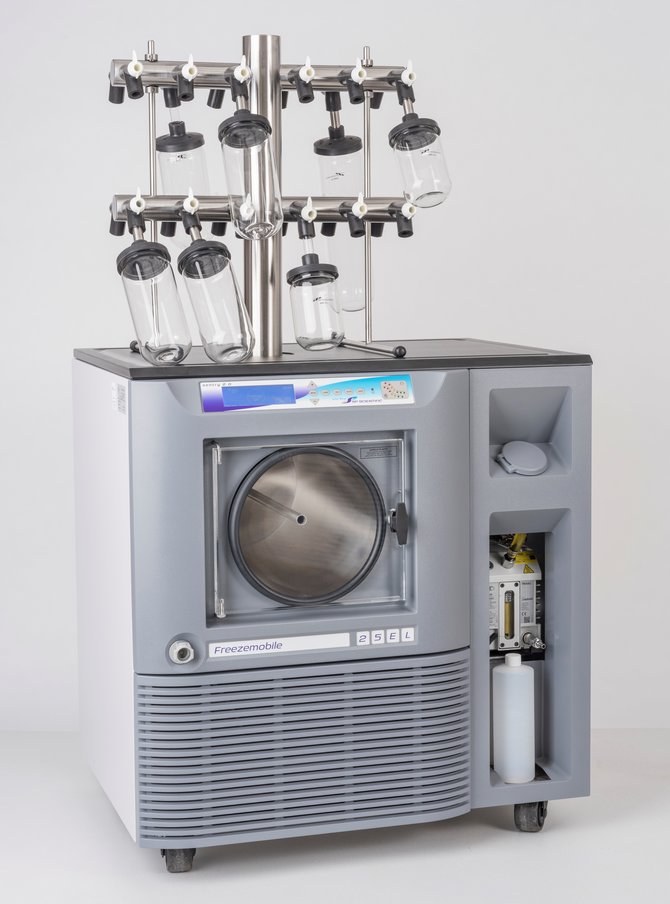
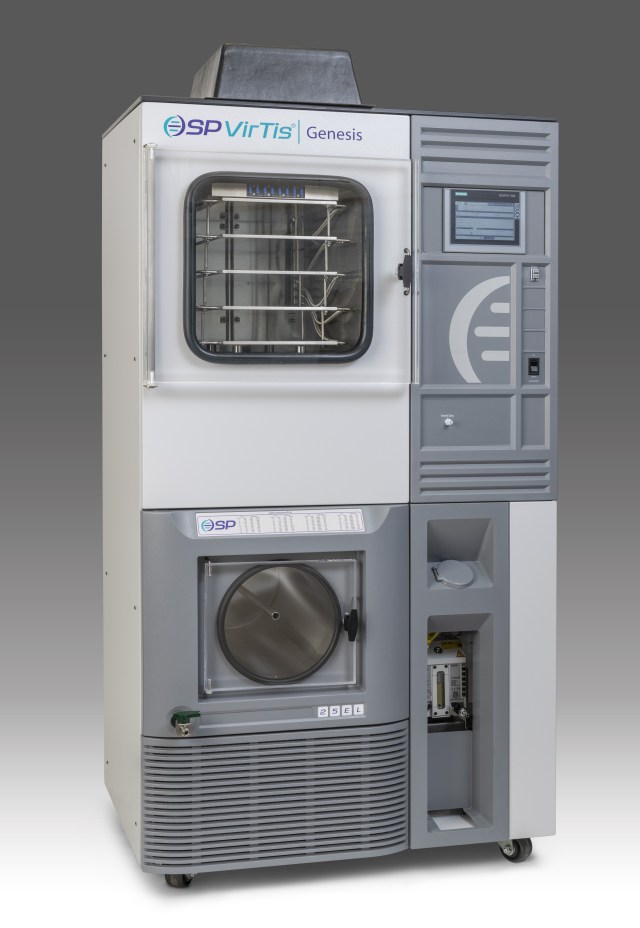
Freeze dryers can also be grouped by size & use:
- Laboratory bench-top units for R&D
- Pilot units for process development and scale-up studies
- Larger production-sized units.
It should be noted that in addition to process scale-up work, pilot-sized freeze dryers are often also used for product R&D as well as for small volume production applications.
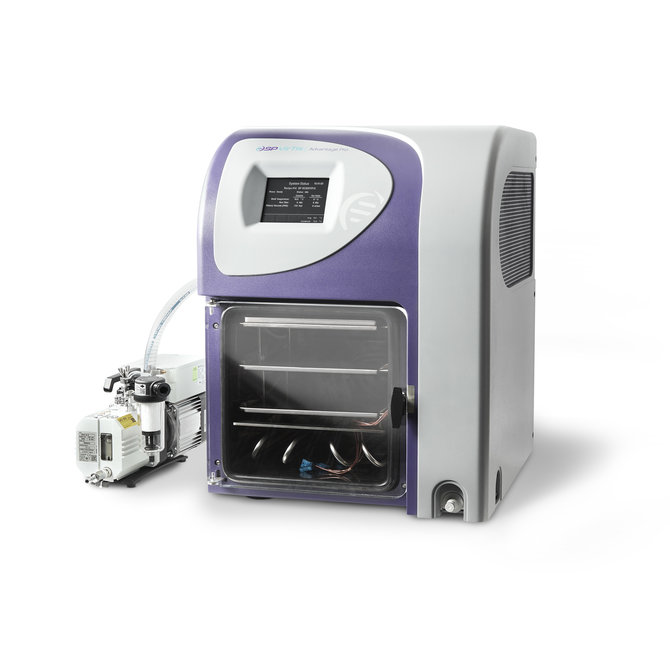
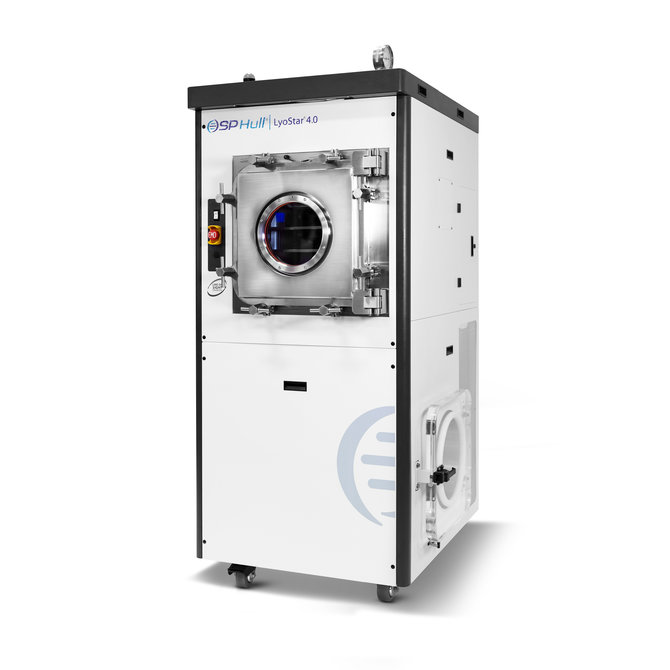
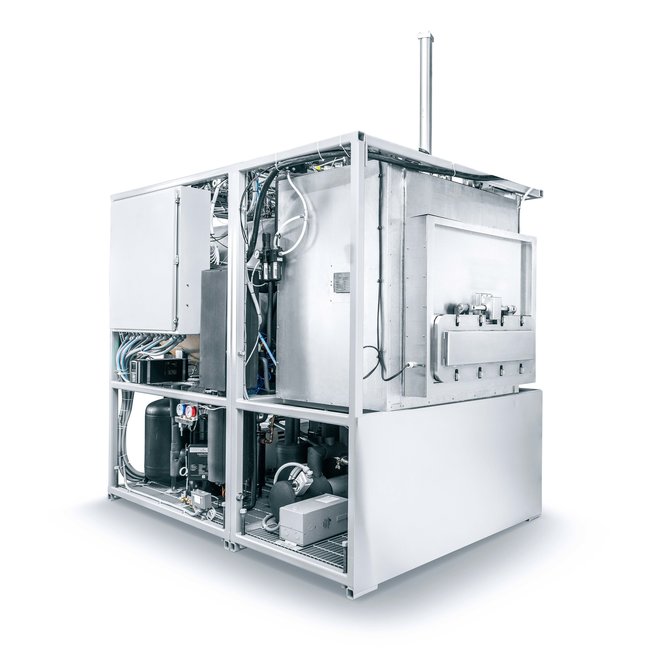
Choosing a freeze dryer depends on the product characteristics as well as many other application-based variables including the container that the product will be dried in, the shelf area or number of ports required to accommodate the quantity to be dried in each batch, the total volume of ice to be condensed and whether there are any organic solvents. The type and shape of product being dried and its end-use also need to be considered.
Together, these refrigeration, vacuum, chamber, and condenser systems create the controlled conditions required for freeze-drying to take place.
In the next article, attention shifts from the equipment to the product itself, including the containers, containment systems, and material properties that determine how a product behaves during freeze-drying.