







Freeze-Drying Basics (Part Three): Products, Containers & Formulation


With the freeze-dryer and its core systems defined in the previous article, the next step is to examine what is placed inside it. Product containers, containment systems, and material properties all play a major role in determining how a formulation freezes, dries, and ultimately performs after lyophilization.
Choosing the Right Containers & Containment Systems
A suitable container system must be chosen for the product. The most common product containers are flasks, vials and trays. If possible, it is advisable to pick a container that keeps the maximum thickness of the product to less than 2 cm (3/4 inch). Special containers made of GORE-TEX & Tyvek® are also available for specific applications where product contamination is a concern.
Product trays with removable bottoms are available when working with vials. The tray is loaded with vials, placed on a shelf in the freeze dryer and then the bottom part of the tray is slid out. This allows the vials to rest directly on the shelf and increases the heat transfer to the product.
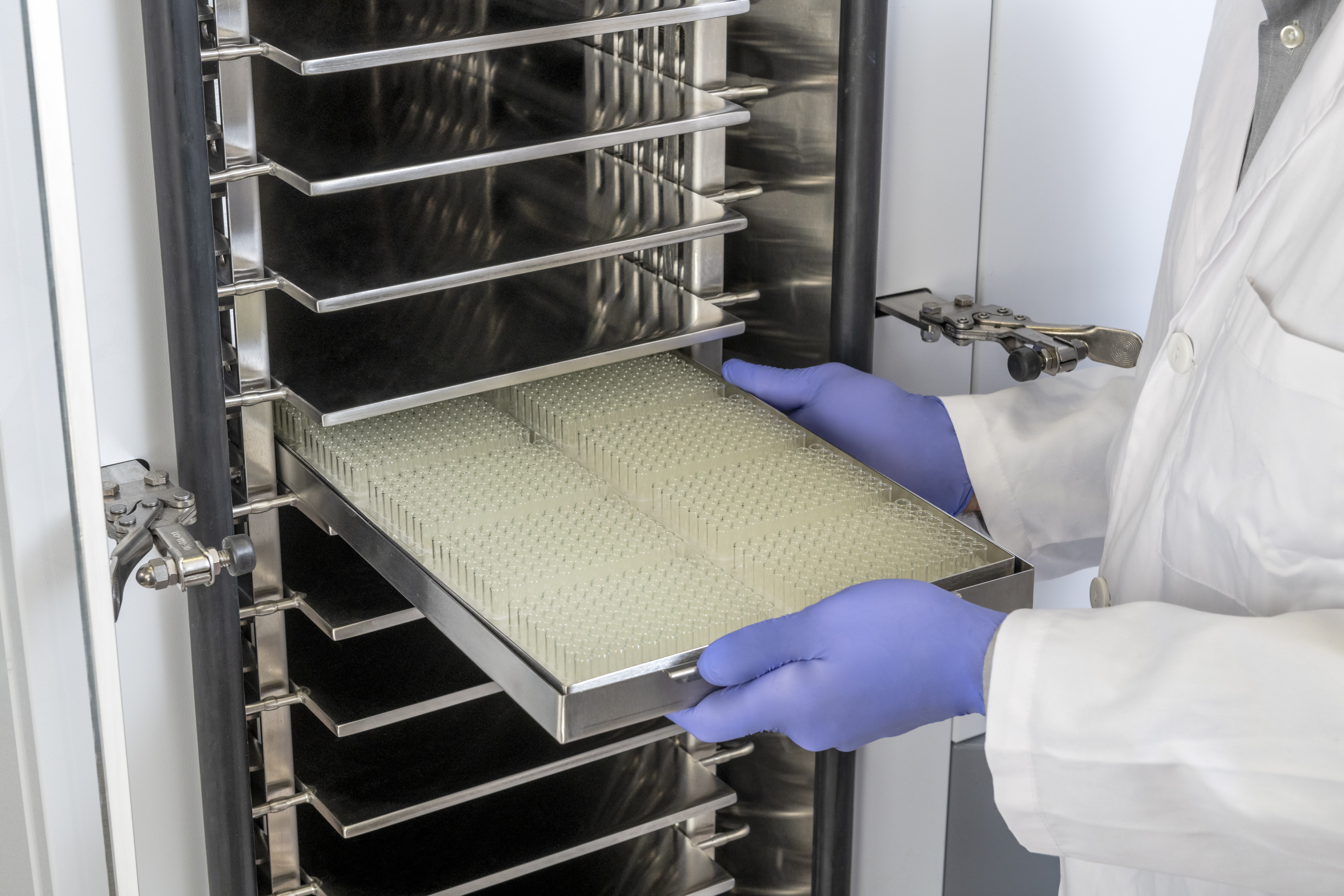
Special containment systems such as isolators and glove boxes are required for freeze-drying certain products, especially when cytotoxic materials are present.
Physical Properties of Materials & Formulation
Understanding the physical properties of materials that are freeze-dried is a key part in developing a successful lyophilization process. Although a few products are simple crystalline materials, the vast majority of products that are lyophilized are amorphous and form glassy states when frozen.
Processing and formulation development are important steps often taken to make a product ready for freeze-drying and usable for its specific application. The choice of excipients added to a formulation can severely affect the thermal characteristics of the product and its ability to be freeze-dried in a reasonable amount of time.
These physical and formulation characteristics directly influence how a product must be processed during freeze-drying.
In the next article, these properties will be used to design a freeze-drying cycle, including freezing behavior, collapse temperature, annealing, and solvent considerations.